Looking notes · 3DGS
Looking again at Shen Hai and Qing Tu
At By Art Matters in Hangzhou, Planets: Battle, Paper marks Mexican artist Damián Ortega’s first major solo exhibition in China. His large-scale sculptures draw on traditional Mexican Judas figures and Transformers imagery.
Gallery MateBy Art Matters · 天目里美术馆
This looking note begins with a tribute to Funes and the app 梁柱之间. Funes records architecture and cultural heritage through an explorable 3D archive; 梁柱之间 brings together interactive models of historic Chinese buildings, photography and historical sources. Both inspired a simple thought: looking can continue after we leave a place. Starting with our own exhibition photographs, we wanted to give Shen Hai and Qing Tu a form we could turn around and revisit.
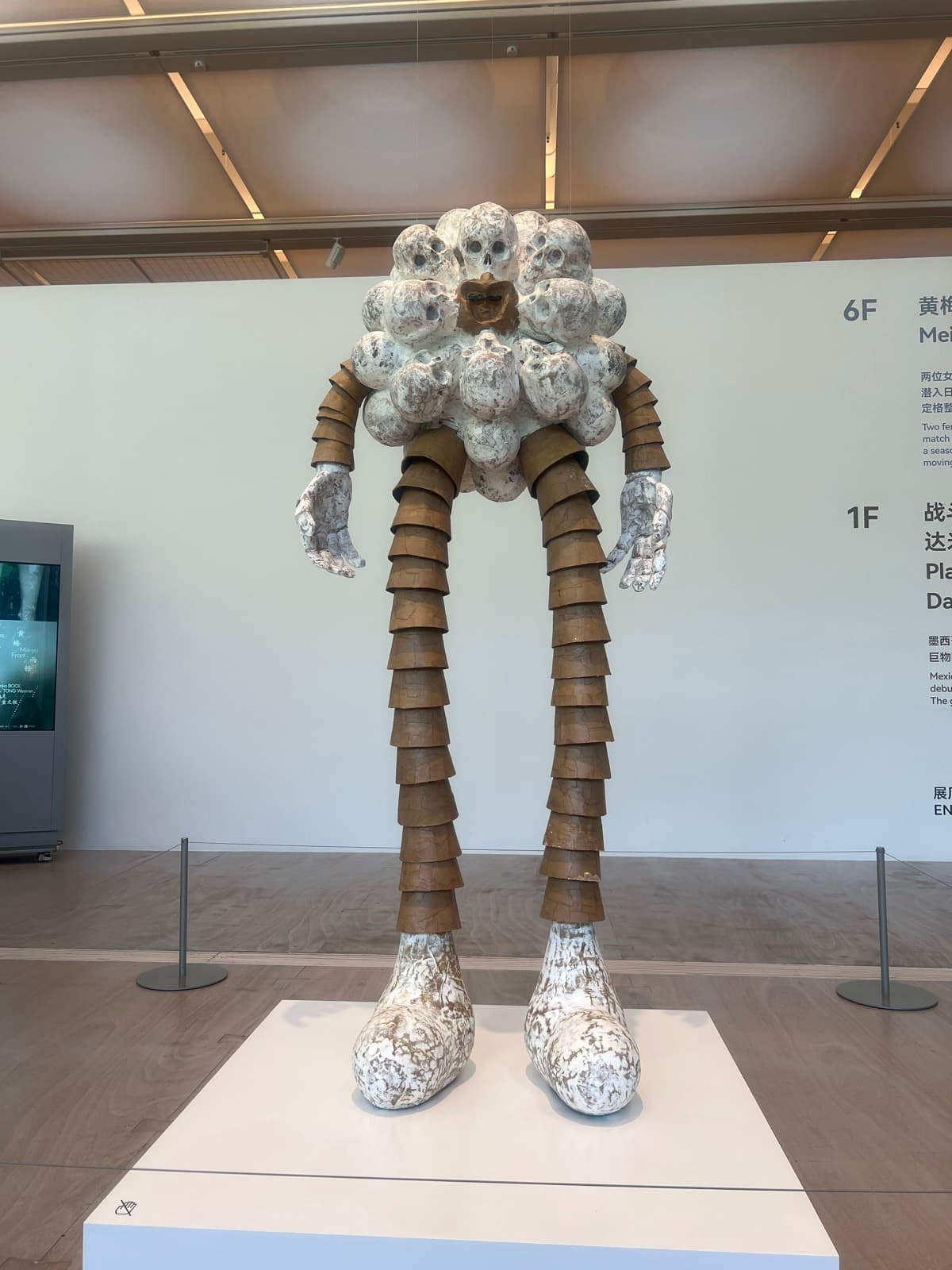
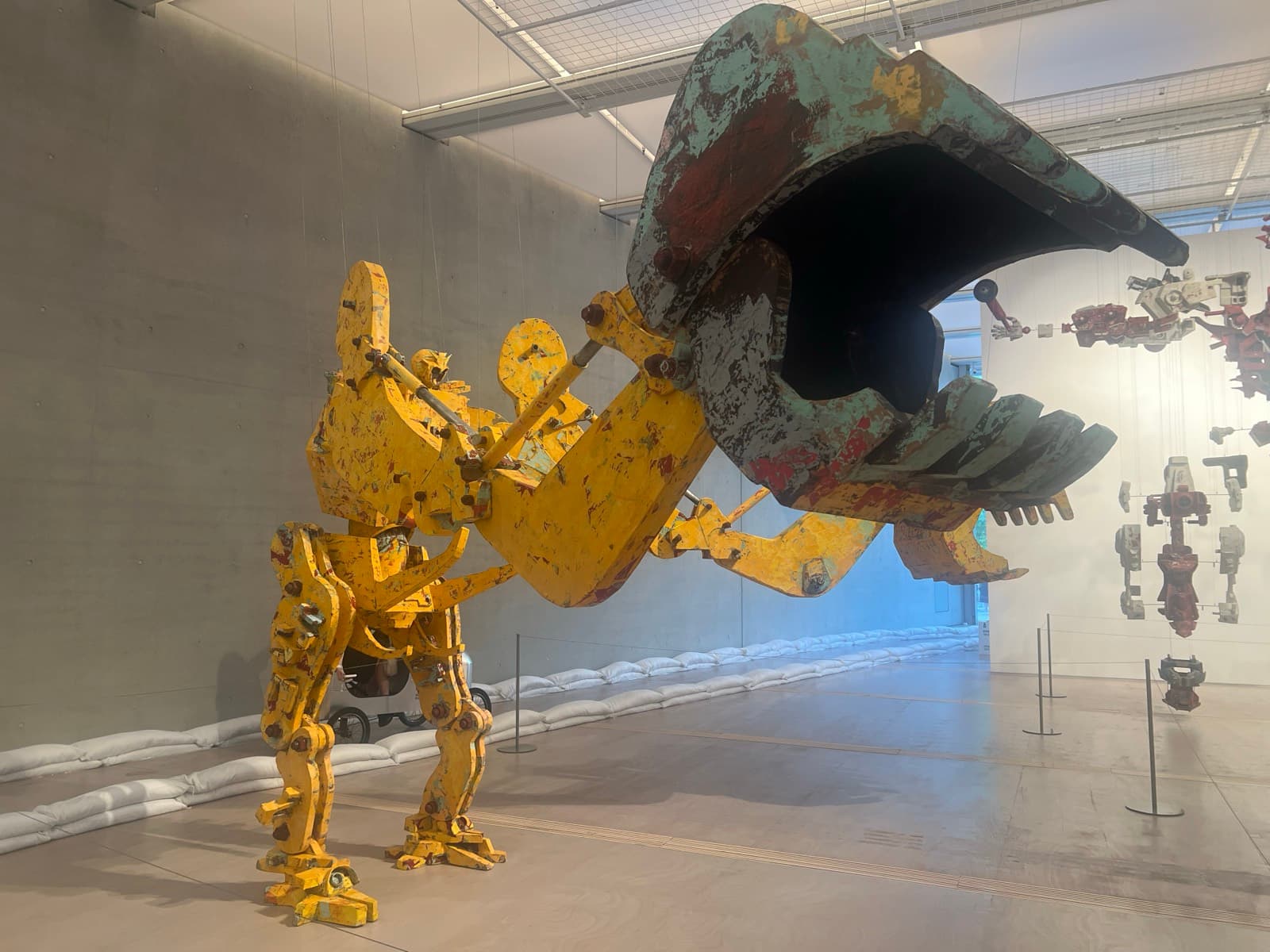
In this visit to By Art Matters, Shen Hai (神骸) and Qing Tu (擎土) left very different silhouettes in the journal: one dense and inward-looking, the other open and extended. Their photographs preserve a particular viewpoint, while recalling the feeling of moving around an artwork.
On September 21, we used one photograph of each work to generate a 3DGS in Gallery Mate. This page brings the source images and generated models together: a chance to notice which forms remain familiar, and which details change as the viewpoint moves.
01 / 02
Shen Hai · 神骸
Starting with a dense front view
In the photograph of Shen Hai, pale skull-like forms gather around a smaller face at the centre. Brown, segmented limbs give the figure an armour-like rhythm. The dense front-facing details catch the eye first; on a second look, follow the outer silhouette and the gaps between the joints.
Look closer: compare the layers around the head and shoulders with the photograph, then turn the model slightly to watch the outline change.
02 / 02
Qing Tu · 擎土
Following the mechanical limbs
The photograph of Qing Tu has a sense of movement toward the viewer. Bright yellow components extend in several directions, while a dark opening close to the camera occupies one side of the frame. Its effect comes from distance, direction and overlapping parts. Follow the view from that opening toward the yellow structure behind it.
Look closer: turn from the front opening toward the yellow components and compare their overlap. Treat shapes beyond the source view as generated interpretations.
Behind the scenes: from photographs to TripoSplat
Generating from one photograph
Both models were generated with TripoSplat on fal (tripo3d/triposplat). This open-source model from TripoAI / VAST AI Research takes a single 2D image and produces 3D Gaussians. For this experiment, we submitted one exhibition photograph per artwork, rather than capturing a series of views around each object.
What is 3DGS?
Think of 3D Gaussian Splatting (3DGS) as representing an object with many small, soft blobs, each with a position, shape, colour and opacity. A renderer projects and blends them into an image. This is neither a photograph placed on a flat plane nor the triangle mesh used in many conventional 3D models: changing the viewpoint reveals different silhouettes and overlaps.
Bringing the result to the browser
The Gallery Mate server submits the photograph URL to fal with output_format set to splat, then saves the resulting .splat file. This article renders it with Spark and Three.js. The viewer and model load only when you choose “Explore in 3D”. Rotating and zooming explore the saved result; they do not trigger another generation request.
Further reading: TripoSplat documentation on fal · Original 3D Gaussian Splatting research
Generation is not scanning
Backs, depth and hidden surfaces absent from the photograph must be inferred and may differ from the actual artworks. Our tribute to Funes and 梁柱之间 is to the idea of continued looking, not a claim that this single-image experiment shares their capture or reconstruction workflows. These results support looking and comparison; they are not measurements of the works’ dimensions, materials or complete structure.
Return to the exhibition
Photographs and artwork names come from a publicly shared Gallery Mate journal. The text here offers viewing prompts; consult the artists and museum for official artwork information. English artwork names on this page are romanizations of the recorded Chinese titles.
双展并行 | 战斗、星球与牛皮纸: 达米安·奥尔特加&黄梅雨锋
Read the original journalA photograph keeps one viewpoint. Putting it beside a new way of looking may draw our attention back to something we passed over in the gallery.